Two UPS systems can carry the same 200 kW load, offer the same redundancy, and still be the wrong and the right answer for the same building. The difference is not electrical. It is where the capacity lives, how it grows, and what happens on the day one power stage fails at 2 a.m.
This guide compares the two architectures we build — modular frames from 10 to 600 kVA and tower frames from 10 to 200 kVA — on the parameters that decide a project: redundancy behaviour, part-load efficiency, floor space, service access and ten-year cost. Every figure below comes from our published frame data, not from a generic industry average.
What is the difference between a modular UPS and a tower UPS?
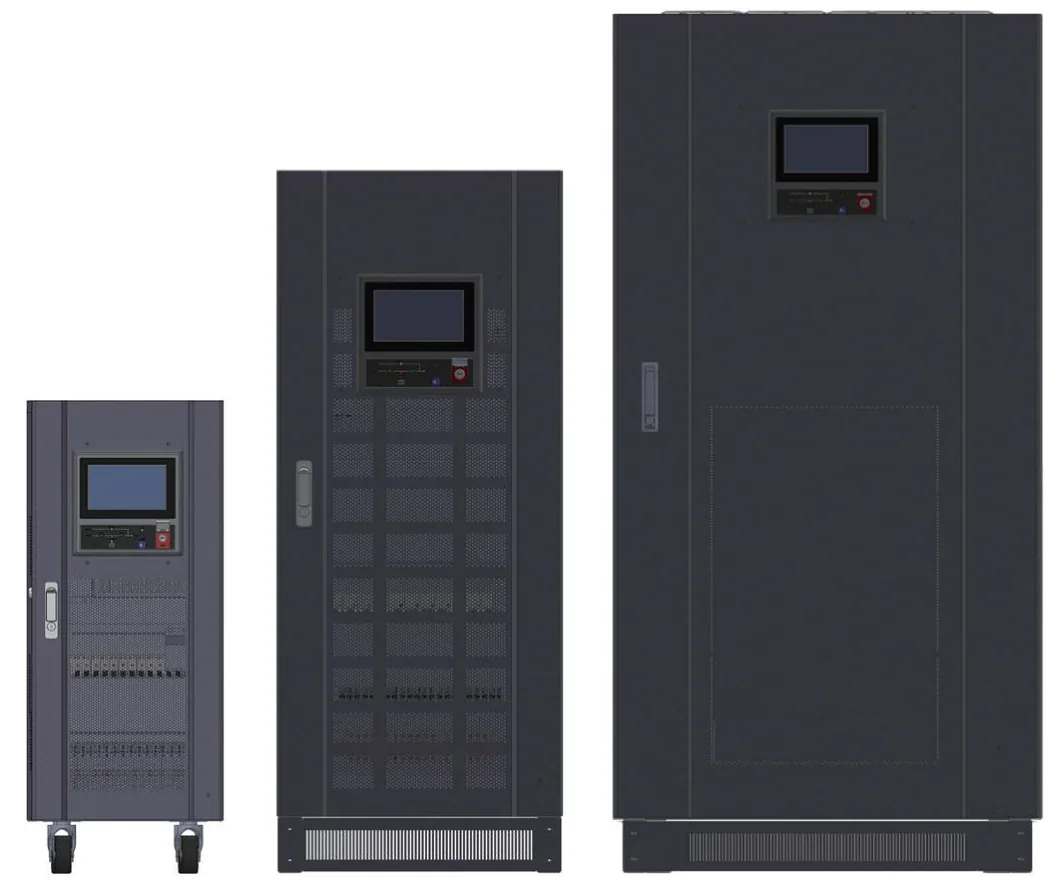
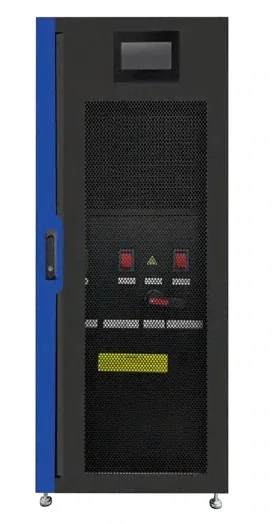
A modular UPS is a frame with empty slots that accept hot-swappable power modules, typically 10–50 kVA each; capacity and redundancy are set by how many modules are fitted. A tower, or monolithic, UPS houses the rectifier and inverter as one fixed block of the full rated capacity.
Both are double-conversion online systems with zero transfer time to battery. Both regulate output to a tight tolerance and both carry a 3:1 crest factor in our current frames. The architecture question is therefore not about power quality at the terminals. It is about capacity granularity, failure domains and how the site will look in five years.
In a modular frame the failure domain is one module. If a 30 kW module fails in a 120 kW frame carrying 90 kW, the remaining modules continue to supply the load and the failed unit is replaced without a bypass transfer. In a tower unit the failure domain is the whole inverter, so the site needs a parallel partner, an external bypass or a shutdown to service it.
How do the two architectures compare on the datasheet?
The two families converge on power quality and diverge on granularity, efficiency and physical growth. The table below compares the published figures for our modular frames (NX, MK and UMK series) against the 3YT and GP tower families, both measured at nominal conditions.
| Parameter | Modular frame (NX / MK / UMK) | Tower frame (3YT / GP) |
|---|---|---|
| Capacity range | 10–600 kVA | 10–200 kVA |
| Capacity step | 10–50 kVA per module | Fixed at rating; parallel units add 30–200 kVA |
| Module slots | 3–10 per frame | Not applicable |
| Redundancy method | N+1 or N+2 by module | Parallel units, up to 4–6 frames |
| AC–AC efficiency | Up to 94.5% | Up to 95.5%; 98.5% ECO on selected frames |
| Input THDi | < 3% at 100% load | < 3% at 100% load |
| Input power factor | > 0.99 at 100% load | ≥ 0.99 at 100% load |
| Output voltage accuracy | ±1% balanced, ±2% unbalanced | ±1% |
| Output THD | ≤ 1.5% linear, ≤ 4% non-linear | ≤ 2% linear, ≤ 5% non-linear |
| Crest factor | 3:1 | 3:1 |
| Overload | 110% 60 min; 120% 10 min; 150% 60 s | 100–110% 60 min; 125% 10 min; 150% 1 min |
| Battery bus | ±192 to ±240 VDC | 192/240 VDC (10–20 kVA); 384 VDC (30–200 kVA) |
| Service access | Front access, hot-swap module | Front access; service needs bypass or parallel unit |
The specification sheet does not settle the choice. Two rows do most of the work: the capacity step and the redundancy method. A site that will double its IT load in four years is buying a growth path, and only one of these architectures sells growth in 30 kW increments.
Where does a modular frame earn its money?
The first gain is capital deferral. A frame is specified for the load the site has plus the slots it will need, and modules are purchased when the load actually arrives. A tower installation either buys the full future capacity on day one or adds a second frame later, with another breaker, battery string and commissioning visit.
The second gain is part-load behaviour. At 40% load, three modules may be carrying the load while a fourth sleeps, and the frame reports higher efficiency than the same electronics would deliver as one oversized block running at 40%. This is the mechanism behind the common claim that modular systems are more efficient, and it is a part-load claim, not a full-load one. Our own modular figure of 94.5% is a peak, and our tower family reaches 95.5% at peak. The honest comparison is annual energy, not a single number.
The third gain is mean time to repair. A hot-swappable module is a swap, not a repair: no bypass transfer, no load interruption, no site visit from a specialist engineer if a spare is held on site. For a facility that cannot take a planned outage, that changes the maintenance contract and the spare-parts stock.
The fourth gain is space. A modular frame is one cabinet that grows internally, with front access that allows row and wall layouts. Frame options as short as 5U and 30U exist in the range, so a small site can start with a shallow cabinet and keep the option of 180 kW of installed capacity in the same footprint.
What does the ten-year cost actually look like?
Energy is the only cost in a UPS comparison that can be calculated from published data alone. At 200 kW of output, our modular peak efficiency of 94.5% draws 211.64 kW at the input; the tower peak of 95.5% draws 209.42 kW. The gap is 2.22 kW, and multiplied over a year at continuous operation it becomes 19,413 kWh.
| Load | Loss difference | Annual energy delta |
|---|---|---|
| 200 kW | 2.22 kW | 19,413 kWh |
| 120 kW | 1.33 kW | 11,648 kWh |
| 90 kW | 1.00 kW | 8,736 kWh |
| 60 kW | 0.66 kW | 5,824 kWh |
Multiply the last column by the local industrial tariff to get an annual figure. The calculation assumes both systems run at their published peak efficiency, which is the most favourable case for the tower unit; the moment the load drops below the tower unit’s rated capacity, the tower runs further from its best point while the modular frame can shed modules. On a 120 kW load served by a 200 kVA tower, the tower is at roughly 60% of rating, and the modular frame in that scenario would be populated for 120 kW with a spare slot rather than bought at 200 kVA.
The costs that are not on the datasheet matter more. Modular capex is front-loaded into the frame and the controller rather than the modules, and the frame is a fixed cost the site pays once. Tower capex rises in steps of whole cabinets. Over ten years, the modular path usually wins when the load grows, because growth is bought at module price; the tower path usually wins when the load is already known and stable, because the site pays for one block of electronics and no more.
Where does a tower UPS still win?
A tower frame is the simpler machine: one controller, one inverter, no module compatibility question and no firmware mismatch between a 2021 module and a 2027 frame. For a site with a stable, measured load and a service contract with an external bypass, the tower frame delivers full-load efficiency about a point higher at a lower first cost per kVA.
Tower frames also remain the right answer where parallel redundancy is acceptable and the electrical room has the floor area. Our 3YT and GP families parallel up to four to six units with a shared battery, which gives N+1 without modules. And the ECO mode on selected tower frames reaches 98.5%, which is attractive in a market where the utility tariff is high and the load is genuinely steady.
The decision rule we apply: fixed load, fixed budget, simple service model — tower. Growing load, mission-critical uptime, limited floor space, or a service contract that cannot accept a bypass transfer — modular.
How do I size the modules for N+1?
Sizing a modular frame is two calculations, not one. The first is the number of modules that carry the load. The second is the number of slots the frame must have, which is larger than today’s requirement because the frame is the part you cannot add later without a new order and a new breaker.
Take a 90 kW critical load on 30 kW modules. Three modules carry 90 kW, so N is three. N+1 is four modules, which is 120 kW installed for a 90 kW load. A frame with three slots cannot hold that configuration, so specify a four-slot or six-slot frame — in our range, the 42U-120 with four slots or the 30U-180 with six. The six-slot frame buys a second growth step in the same cabinet.
Two traps catch projects at this stage. Modules are not universally interchangeable between frames, so the frame bill of materials and the control firmware must be confirmed before signing; and a shared battery bank between frames is supported on selected models only, with protection, cable length and fuse coordination engineered for the parallel arrangement.
What site conditions change the answer?
Footprint decides most retrofits. A 200 kVA tower frame measures 705 mm wide, 1,051 mm deep and 1,646 mm high before battery cabinets and maintenance clearance, so the room must also absorb the battery strings for the required autonomy. A modular frame is one cabinet, but it is the growth path, not the day-one footprint, that the room must accommodate.
Heat rejection belongs in the same conversation. Every kilowatt of UPS loss is a kilowatt the room’s cooling has to remove, so the efficiency difference in the table above is a cooling load as well as an energy bill. At 2.22 kW of extra loss the cooling penalty is small but not zero, and in a sealed room it compounds.
Input conditions decide whether either architecture will behave. Both families accept 305–478 VAC at full load and 208–304 VAC below 70% load, which covers most sags and generator swings. If the feeder sits persistently below that window, the battery will cycle every evening regardless of architecture, and the fix is a stabilizer upstream — the sizing method in How to Size a UPS for an Unstable Grid covers that case.
What should the specification state?
Write the specification around the growth path, not the day-one load. The list below is the one we ask project buyers to complete before a quotation, because each line changes the frame, the module count or the battery, and a missed line is discovered at commissioning rather than at the quotation stage.
- Frame capacity and the number of slots, stated separately from the populated modules
- Module rating and the frame’s confirmed compatibility, including firmware
- Redundancy target — N+1 or N+2 — and whether it must hold at the future load or only today’s
- Battery autonomy in minutes at end of life, battery type (VRLA or LiFePO4) and the bus voltage
- External maintenance bypass, interlocked with the UPS output
- Monitoring path: SNMP, Modbus or dry contacts, and who receives the alarms
- Input window the site actually sees, measured at the feeder rather than quoted from the utility
- Spare module held on site, if the repair-time target depends on it
For the modular range, the modular UPS product page lists the frame and module combinations; the tower comparison sits on the three-phase online UPS page. If the capacity is already known and only the topology is open, the data center power layout page shows how the frames sit in a row with battery cabinets.
Which should you specify?
Choose modular when the load will grow, when a module failure must not reach the load, or when the electrical room has no space for a second cabinet. Choose tower when the load is measured and stable, first cost dominates, and the site can accept a bypass transfer for service.
The mistake to avoid is buying a tower frame oversized for future growth and calling it a growth plan. Oversizing a tower unit costs capital immediately and efficiency continuously, and it does not deliver the redundancy that a fourth module delivers for the price of one module. Send the measured load, the runtime target and the frame you are considering, and we will return the populated-module count and the battery configuration for that specific frame.