
LiFePO4 Battery
More usable cycles and less weight for long runtime.
- 51.2 V
- 50–280 Ah
- 6,000 cycles
Nominal voltage
51.2 V (48 V class)
Capacity
50 / 100 / 200 / 280 Ah
Energy
2.56–14.336 kWh per module
Rated range
50–280 Ah
- Nominal voltage
- 51.2 V (48 V class)
- Capacity
- 50 / 100 / 200 / 280 Ah
- Energy
- 2.56–14.336 kWh per module
- Cycle life
- 6,000 cycles at 80% DOD, 25 °C
- Communication
- RS485 / RS232 / CAN
- Parallel
- Up to 15 modules
LiFePO4 rack modules at 51.2 V and 50–280 Ah with an integrated BMS and roughly 6,000 cycles. Higher purchase cost, but the right choice where battery-room space, weight or replacement frequency dominates the total cost.
What this platform is built to do.
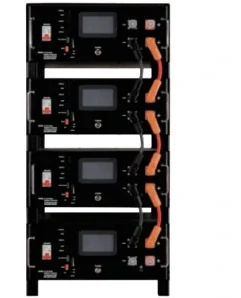
LiFePO4 batteries are used when the runtime is long, the space is tight, or the cycle count is high. A 51.2 V rack module stores 2.56–14.336 kWh, includes a BMS, and communicates over RS485, RS232, or CAN. The chemistry is thermally stable and delivers a flat discharge curve, so the inverter sees a stable DC voltage through most of the discharge.
The rack modules are 19-inch format, 2U–3U high, and can be paralleled up to 15 units. The BMS balances the cells, protects against over/under voltage, overcurrent, and temperature extremes, and reports state of charge to the UPS or inverter. Cycle life is 6,000 cycles at 80% depth of discharge, 25 °C, and 0.5C, with at least 80% capacity retention.
For a UPS, confirm that the charger’s float voltage and charge current match the lithium module’s requirements. A lead-acid charger set to 13.65 V per block may not be suitable without a lithium profile. The module is not a drop-in replacement for a VRLA string unless the UPS has a lithium-compatible charger and communication interface.
Usable capacity
80% depth of discharge without the rapid life loss of lead-acid.
Built-in BMS
Cell balancing, over/under voltage, overcurrent, and temperature protection.
Rack format
19-inch 2U–3U modules with front terminals and status indicators.
Remote data
RS485/CAN telemetry for UPS, inverter, and monitoring systems.
51.2 V rack · 50–280 Ah
Selected models and nominal values. The quotation confirms the exact configuration, battery, and documentation for the project.
Request a model sheetRack LiFePO4 module range
| Model | Voltage | Capacity | Energy | Dimensions (mm) | Weight |
|---|---|---|---|---|---|
| YT-4850 | 51.2 V | 50 Ah | 2.56 kWh | 440 × 484 × 88 | 27 kg |
| YT-48100 (48 V) | 48 V | 100 Ah | 4.8 kWh | 440 × 484 × 178 | 41 kg |
| YT-48100 (51.2 V) | 51.2 V | 100 Ah | 5.12 kWh | 440 × 484 × 178 | 45 kg |
| YT-48200 (48 V) | 48 V | 200 Ah | 9.6 kWh | 440 × 796 × 178 | 74 kg |
| YT-48200 (51.2 V) | 51.2 V | 200 Ah | 10.24 kWh | 440 × 796 × 178 | 78 kg |
| YT-48280 (51.2 V) | 51.2 V | 280 Ah | 14.336 kWh | 405 × 750 × 230 | 105 kg |
Electrical
- Nominal voltage
- 51.2 V
- Capacity
- 50 / 100 / 200 / 280 Ah
- Energy
- 2.56 / 5.12 / 10.24 / 14.336 kWh
- Charge voltage
- 57.6 V (51.2 V models)
- Discharge cut-off
- 43.2–44.8 V, model-dependent
- Continuous discharge
- 50–140 A, model-dependent
- Cycle life
- 6,000 cycles at 80% DOD, 25 °C
Mechanical and environment
- Format
- 19-inch rack, 2U–3U
- Dimensions
- 440 × 484 × 88 mm (50 Ah); 440 × 796 × 178 mm (200 Ah)
- Weight
- 27–105 kg, model-dependent
- Operating temperature
- 0–40 °C (charge); discharge range wider
- Storage humidity
- 65 ± 20% RH
- Protection
- IP20
- Certification
- CE, RoHS, FCC, UN38.3, MSDS
Control and safety
- BMS
- Integrated, with cell balancing and protection
- Communication
- RS485 / RS232 / CAN; WiFi, 4G, Bluetooth optional
- Parallel
- Up to 15 modules
- Fire suppression
- Aerosol pack on selected models
- Warranty
- 5–10 years, terms confirmed per order
Key specifications
| Parameter | Value |
|---|---|
| Nominal voltage | 51.2 V (48 V class) |
| Capacity | 50 / 100 / 200 / 280 Ah |
| Energy | 2.56–14.336 kWh per module |
| Cycle life | 6,000 cycles at 80% DOD, 25 °C |
| Communication | RS485 / RS232 / CAN |
| Parallel | Up to 15 modules |
Selection notes for this family
| Question | What to check | Why |
|---|---|---|
| Load profile | Running kW and largest step for 50–280 Ah | Avoid overload and oversizing |
| Runtime | Battery bank and charger for the target minutes | Actual autonomy |
| Environment | Temperature, altitude, dust and ventilation | Life and derating |
| Interface | Monitoring, bypass, parallel requirement | Integration with the room |
| Documentation | Conformity route and model test report | Customs and tender |
Where this family fits.
These are the load types the platform is specified for. If your load is outside this list, send the load profile before selecting the model.
- Data-center battery rooms
- Telecom sites
- Solar and hybrid storage
- Industrial backup
- Long-runtime UPS
LiFePO4 battery: project questions.
Project-specific answers. If your question is not here, send the load list and the site conditions.
Talk to an engineer Can I replace a VRLA string with LiFePO4?
Only if the UPS charger supports the lithium voltage profile and the BMS can communicate with the UPS. A lead-acid charger may overcharge or undercharge a lithium module, and the UPS may not recognize the battery status.
How many modules can be paralleled?
Up to 15 modules on the rack range, subject to the BMS and the inverter’s DC current limit. Confirm the busbar, fuse, and cable sizing for the total current.
What is the usable energy at 80% DOD?
A 10.24 kWh module delivers about 8.2 kWh at 80% DOD. The inverter efficiency and the end-of-discharge voltage reduce the delivered AC energy further.
Does the BMS need a communication cable to the UPS?
For full protection and state-of-charge reporting, yes. Some installations run the battery in voltage-control mode without communication, but the UPS then cannot see the BMS limits.
Are the modules UN38.3 certified?
The range is listed with CE, RoHS, FCC, UN38.3, and MSDS documentation. Confirm the exact model and the shipping documents before booking transport.
How long is the warranty?
The range is offered with a 5–10 year warranty depending on the model and the cycle profile. The final terms are confirmed in the quotation.
Send the load list. We will return the configuration.
Tell us the kW, the backup time, the phase, and the site country. You will get a capacity recommendation, a battery configuration, and the model sheet.
- Capacity and topology recommendation
- Battery bank and runtime estimate
- Model sheet and commercial offer
Request a configuration and quotation
Send the load list, backup time, and site conditions. We will return a capacity recommendation, battery configuration, and commercial offer.