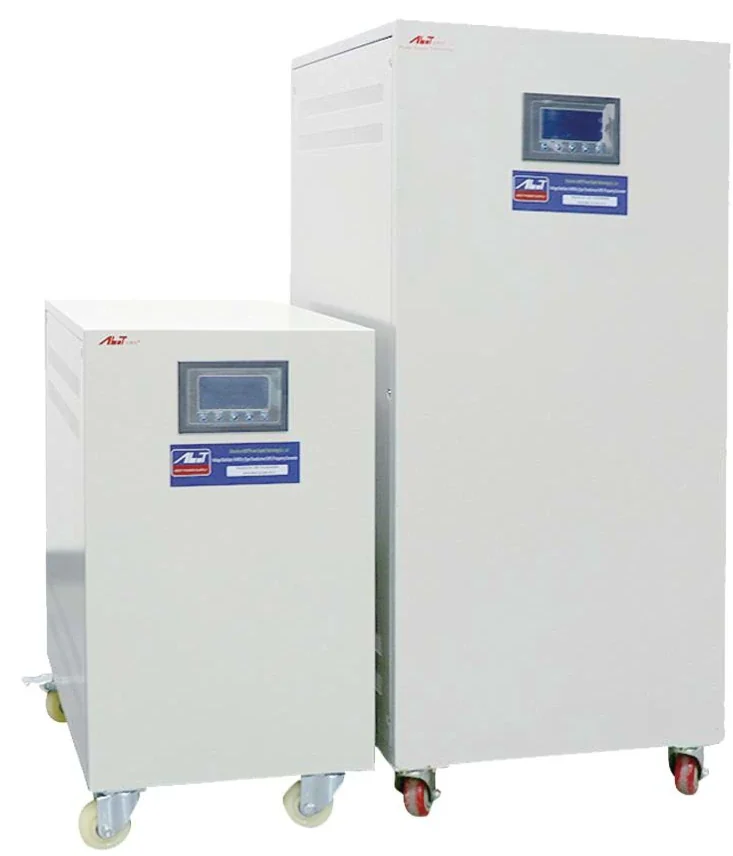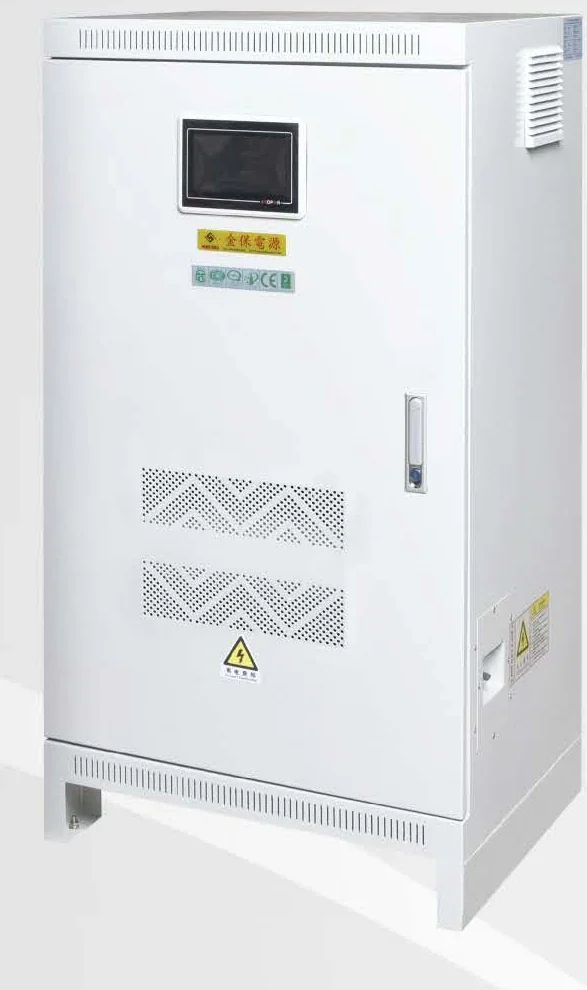
A voltage stabilizer is often specified by the word “AVR” and a kVA number. That is not enough to choose between the two main mechanisms. A servo stabilizer and a contact-type stabilizer both correct voltage, but they trade input range against accuracy, and they behave differently on a weak grid.
This article compares the two mechanisms using the specifications from the SVC and KPD ranges, then shows how to measure the site before choosing.
What is a servo voltage stabilizer?
A servo stabilizer uses a motor-driven carbon brush on a toroidal autotransformer. The control circuit senses the output, drives the servo motor, and moves the brush to change the turns ratio. A compensation transformer adds or subtracts voltage, holding the output at the setpoint.
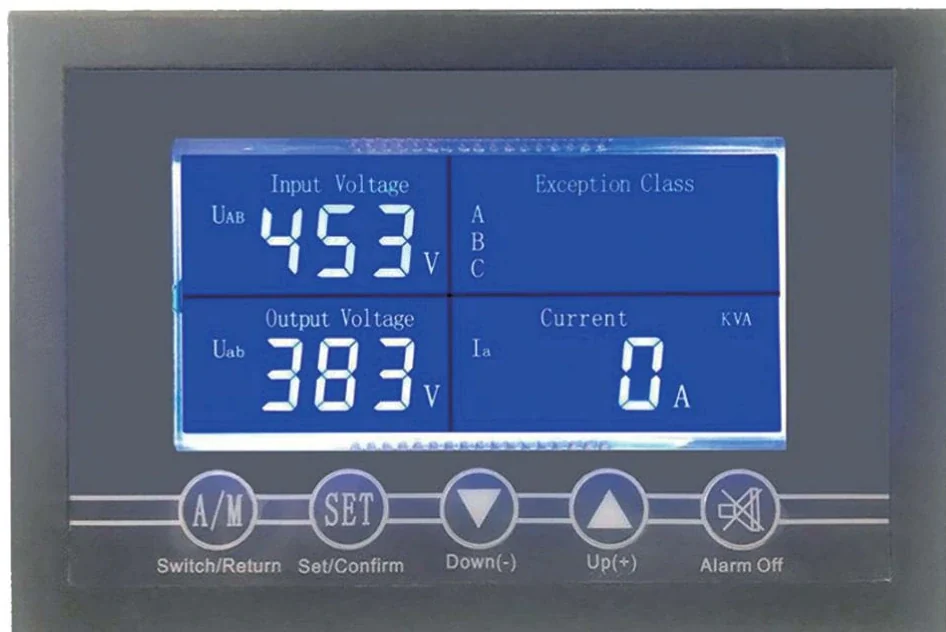
The SVC range covers 10–30 kVA single-phase with a 160–260 VAC input and 10–100 kVA three-phase with a 304–456 VAC input. Output accuracy is ±2%, efficiency is above 98%, and the response time is under 1 second for a 10% input step. The three-phase models regulate each phase independently.
The advantage is the wide correction range. The disadvantage is the mechanical response time and the maintenance of the brush and track.
What is a contact-type AVR?
A contact-type AVR uses a disc-wound autotransformer and a carbon brush. The brush moves across the disc to change the turns ratio. The KPD-10KVA accepts 220 VAC ±20%, delivers 220 VAC ±1% at up to 45 A, and has a design life of 20 years.
The advantage is precision: ±1% is tighter than the servo’s ±2%, and the output can be adjusted within a ±1–5% window. The disadvantage is the narrower input range. A site that falls to 160 V is outside the KPD’s ±20% window (176 V minimum) and the unit cannot hold the output.
| Criterion | Servo (SVC) | Contact (KPD) |
|---|---|---|
| Input window | 160–260 VAC 1-phase; 304–456 VAC 3-phase | 220 VAC ±20% |
| Output accuracy | ±2% | ±1% (adjustable ±1–5%) |
| Capacity | 10–100 kVA | 10–30 kVA |
| Phase | Single and three-phase | Single-phase |
| Response | <1 s for a 10% step | Model-dependent |
| Efficiency | >98% | ≥95% |
| Best for | Wide swings, three-phase | Precision on a moderate grid |
How do I measure the input before choosing?
Log the voltage for at least a week at the distribution board that will feed the stabilizer. Record the lowest and highest phase-neutral voltage, the phase imbalance, and the frequency. If the site has a generator, log the voltage during generator operation as well.
The worst-case value decides the input range. If the lowest voltage is 185 V, the KPD with a 176 V minimum is marginal and the SVC with a 160 V minimum is safer. If the voltage stays within 200–240 V, the KPD can deliver ±1% precision without the wider servo mechanism.
The measurement also shows whether the problem is a sustained undervoltage or a fast transient. A stabilizer corrects the sustained deviation; it does not clamp a lightning transient. For transients, use a surge protective device.
| Measured condition | Likely cause | Recommended device |
|---|---|---|
| 185–205 V sustained | Weak feeder or long cable | Servo AVR |
| 250–265 V sustained | Utility overvoltage or transformer tap | Servo or contact AVR |
| ±10 V phase imbalance | Unbalanced single-phase loads | Three-phase servo with independent phases |
| Fast spikes | Switching or lightning | SPD, not a stabilizer |
| Complete outage | Utility or generator failure | UPS, not a stabilizer |
When is ±1% worth the narrower range?
The ±1% contact-type AVR is worth it when the load is sensitive to a small voltage window and the input is reasonably stable. Examples are laboratory analyzers, medical equipment, broadcast studios, and precision test benches. In those cases, the extra 1% can matter more than the wider input range.
For a factory, a hotel, or a building with large motors and air conditioners, the ±2% servo stabilizer is usually the better fit. The input swing is wider, the load is less sensitive to 1%, and the three-phase independent regulation handles the unbalanced single-phase loads.
The decision is not “which one is better.” It is “which one matches the measured input and the load tolerance.”
What maintenance does each need?
Both types use a carbon brush and a contact track. The brush wears with every regulation movement, and the track collects carbon dust. The maintenance interval depends on how often the input moves and the load current.
A practical schedule is to inspect the brush and clean the track every 6–12 months, check the servo motor and drive for wear, verify the output calibration with a true-RMS meter, and test the over/under voltage and phase-loss protections. Keep a spare brush and fuse set for critical sites.
The contact-type AVR has a simpler mechanism, but it is not maintenance-free. The disc surface and the brush still wear. The servo unit adds a motor and a drive belt or gearbox, which also need inspection.
| Maintenance item | Servo | Contact |
|---|---|---|
| Brush inspection | Every 6–12 months | Every 6–12 months |
| Track cleaning | Yes | Yes |
| Motor / drive | Inspect belt or gearbox | Not applicable |
| Output calibration | Annual | Annual |
| Protection test | Annual | Annual |
How do I size the stabilizer?
Add the running kVA of the protected loads and add 20–30% margin. At a 0.8 power factor, a 30 kVA stabilizer delivers 24 kW. If the load is 24 kW at 0.7 PF, the required kVA is higher.
Check the largest motor start. A direct-on-line motor can draw 5–7 times rated current. A stabilizer can supply a motor within its rating, but the starting current may trip the protection. Use a soft starter or oversize the stabilizer after a load study.
Do not include the whole building if only the critical equipment needs protection. A dedicated stabilizer for the production line, the lab, or the IT room is often more economical than a building-wide unit.
| Load | kVA at 0.8 PF | Stabilizer | Phase |
|---|---|---|---|
| 4 kW | 5 kVA | 5 kVA | Single |
| 8 kW | 10 kVA | 10 kVA | Single |
| 16 kW | 20 kVA | 20 kVA | Single or three |
| 24 kW | 30 kVA | 30 kVA | Three |
| 40 kW | 50 kVA | 50 kVA | Three |
| 80 kW | 100 kVA | 100 kVA | Three |
The decision in one page
- Measure the input for a week; use the worst-case value.
- Choose the servo AVR for a wide input window and three-phase independent regulation.
- Choose the contact AVR for ±1% precision on a moderate grid.
- Do not use a stabilizer as a UPS; it does not provide backup.
- Add an SPD for transients; a stabilizer is not a surge arrester.
- Plan brush and track maintenance for both types.
A stabilizer is a long-life asset, but it is not maintenance-free. The right choice is the one that matches the measured grid, the load tolerance, and the maintenance capability of the site.