
Servo stabilizer: wide-range correction with ±2% output.
SVC servo stabilizer from 0.5 to 100 kVA, single and three-phase, 150–456 VAC input, ±2–3% output, >98% efficiency and RS485 monitoring.
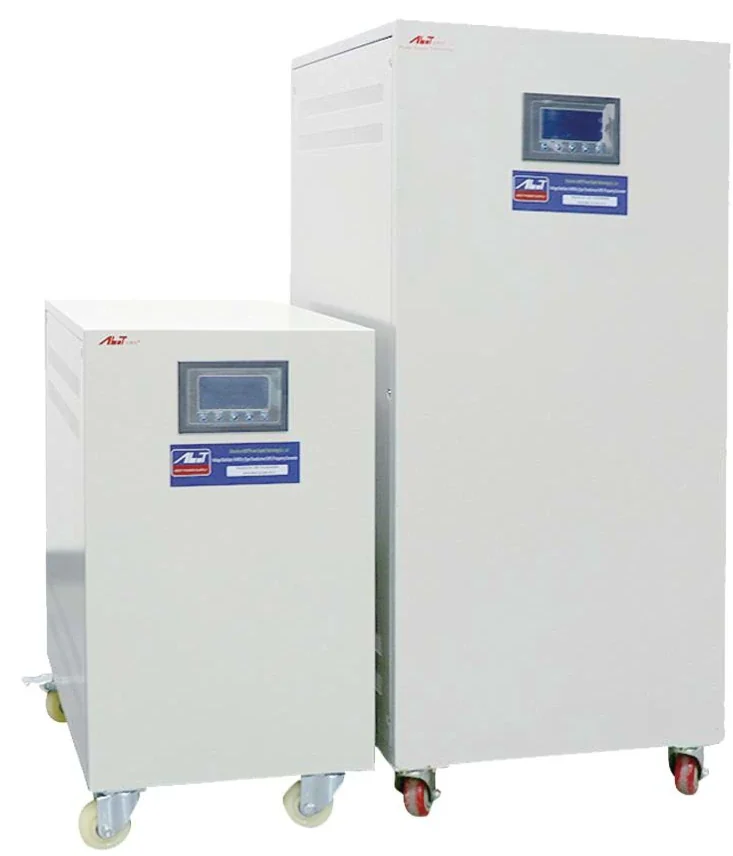
- Input window
- 160–456 VAC
- Output accuracy
- ±2%
- Efficiency
- >98%
- Protections
- 28
The servo stabilizer is the workhorse of voltage correction in weak-grid markets. Its motor-driven brush and toroidal transformer can correct a wide input window, and its three-phase version regulates each phase independently. It is used at the incoming supply of factories, hotels, hospitals, and commercial buildings.
The SVC range covers 0.5–100 kVA: the 0.5–5 kVA single-phase models are ±3%, and the 10–100 kVA single/three-phase models are ±2%. Efficiency is above 98%, with a 5.5-inch LCD and RS485/MODBUS-RTU. It is not a UPS; it corrects voltage but does not provide backup.
What input range can a servo stabilizer correct?
The single-phase SVC accepts 160–260 VAC and outputs 220 VAC ±2%. The three-phase SVC accepts 304–456 VAC line-to-line and outputs 380/400/415 VAC ±2%. The correction range is wide enough for most weak-grid sites, but it is not infinite: below 160 V single-phase or 304 V three-phase, the unit cannot hold the output.
Measure the worst-case voltage before selecting the unit. If the site regularly falls below the range, the upstream transformer or feeder needs attention, or a different product (such as a wide-input UPS) is required.
How does independent phase regulation work?
Each phase has its own sensing circuit, servo motor, and brush. If phase A is at 210 V, phase B at 230 V, and phase C at 245 V, each phase is corrected to its own setpoint. The load sees a balanced supply even when the input is unbalanced.
This is important for buildings with single-phase loads distributed across phases. Without independent regulation, the phase voltages can diverge and sensitive equipment on the low phase can trip.
Why is the efficiency above 98%?
The servo stabilizer corrects voltage with a transformer and a brush, not with a double conversion. The losses are mainly the transformer copper and iron losses, so the efficiency is high. The output waveform is not regenerated, so there is no additional harmonic distortion.
The trade-off is speed: the mechanical servo takes up to 1 second to correct a 10% step. For fast transients, a UPS or an electronic regulator is faster.
What does installation require?
- A dedicated input breaker sized for the stabilizer current
- Copper busbar or cable terminals for input and output
- A ventilated indoor location with 0.8–1 m front clearance
- A level floor capable of supporting the cabinet weight
- A maintenance bypass for critical loads
- A true-RMS meter for commissioning and calibration
- A surge arrester upstream, where lightning is a risk
Which standards and documents are referenced on this page?
The table lists the model-specific standards and conformity documents a project buyer should ask for. Availability depends on the frame, the battery, and the destination market; request the document that names your model.
Voltage stabilizer and AVR standards
| Reference | What it covers |
|---|---|
| IEC 61558-1 | Safety of power transformers and supply units |
| IEC 61000-3-2 | Harmonic current emission limits |
| IEC 61000-3-3 | Voltage fluctuation and flicker limits |
| IEC 62040-3 | Interface performance when feeding a UPS input |
| JB/T 10089 | Contact-type AC voltage stabilizer standard |
| GB/T 12325 | Voltage deviation limits for supply systems |
| CE / RoHS | EU conformity and restricted-substance declaration |
| ISO 9001 | Manufacturing quality management system |
| RS485 / MODBUS-RTU | Remote monitoring interface |
| IP20 / IP21 | Enclosure protection for indoor installation |
Certificates are issued against the exact model and configuration. See the certifications page for how to confirm scope and revision, or send the model to request the current document.
Confirm the inputs and documents before quoting.
Project inputs to confirm
| Item | What to confirm | Why it matters |
|---|---|---|
| Load | Running kW, largest motor, load step | Sets kVA, overload and topology |
| Runtime | Minutes, generator availability, battery room | Sets battery bank and charger |
| Supply | Voltage, frequency, phase, input current | Sets model, breaker and cable |
| Site | Country, altitude, ambient temperature, dust | Sets derating, IP and documents |
| Battery | VRLA, LiFePO4, footprint, weight limit | Sets chemistry and room layout |
| Documentation | Conformity route, test report, language | Sets document package and lead time |
Documentation package
| Document | Contents | Typical use |
|---|---|---|
| Model datasheet | Ratings, input/output, battery, dimensions | Design and tender |
| Dimension drawing | Cabinet size, terminals, clearance | Room layout |
| Single-line diagram | UPS, bypass, battery and breakers | Electrical design |
| Battery configuration | String voltage, blocks, runtime basis | Battery procurement |
| Test report | Model-specific IEC 62040 or CE report | Compliance and customs |
| Packing list | Dimensions, weight, HS code, marks | Shipping and clearing |
Match the page to a platform.
SVC Series · 0.5–100 kVA
Servo Voltage Stabilizer
±2% output from a 160–456 V input swing.
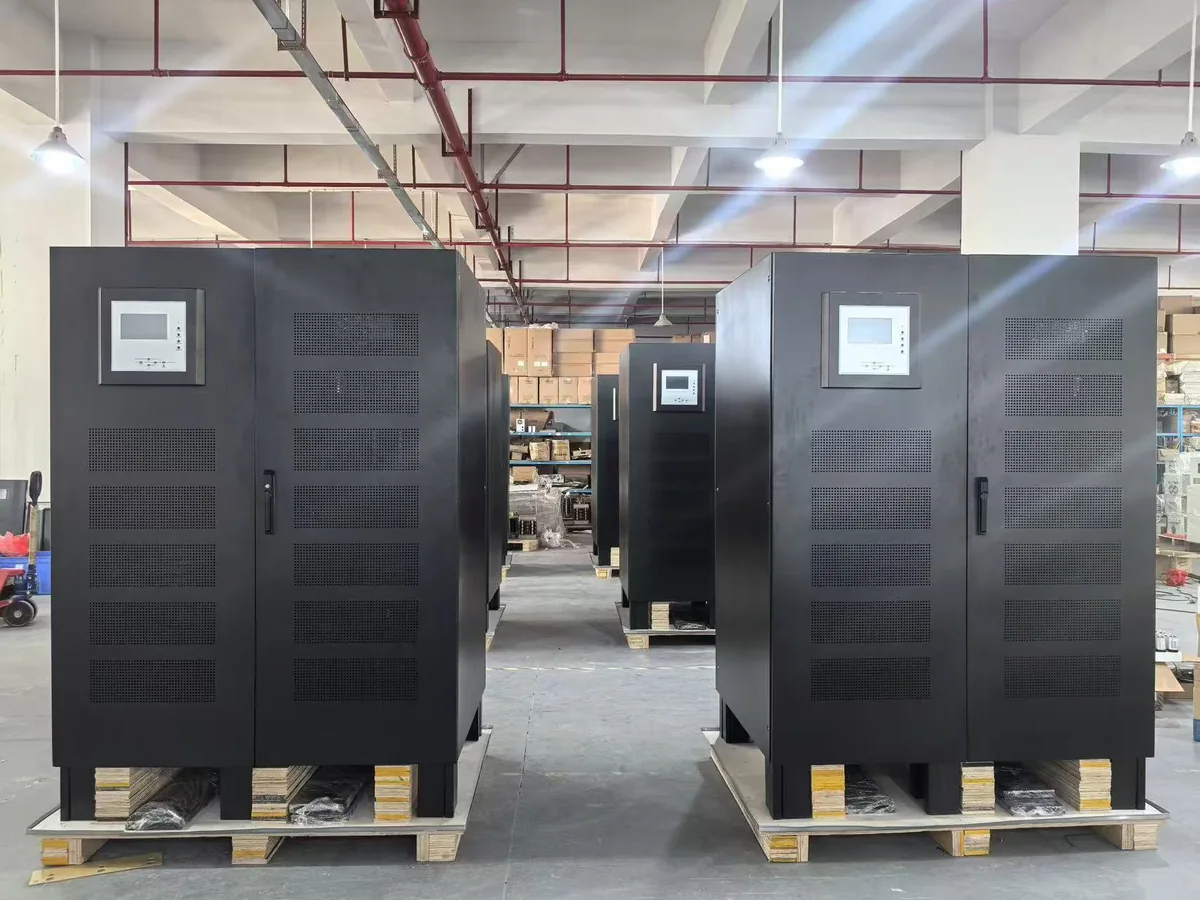
SVC-T Series · 10–100 kVA
Three-Phase Voltage Stabilizer
Independent phase regulation for unbalanced three-phase loads.
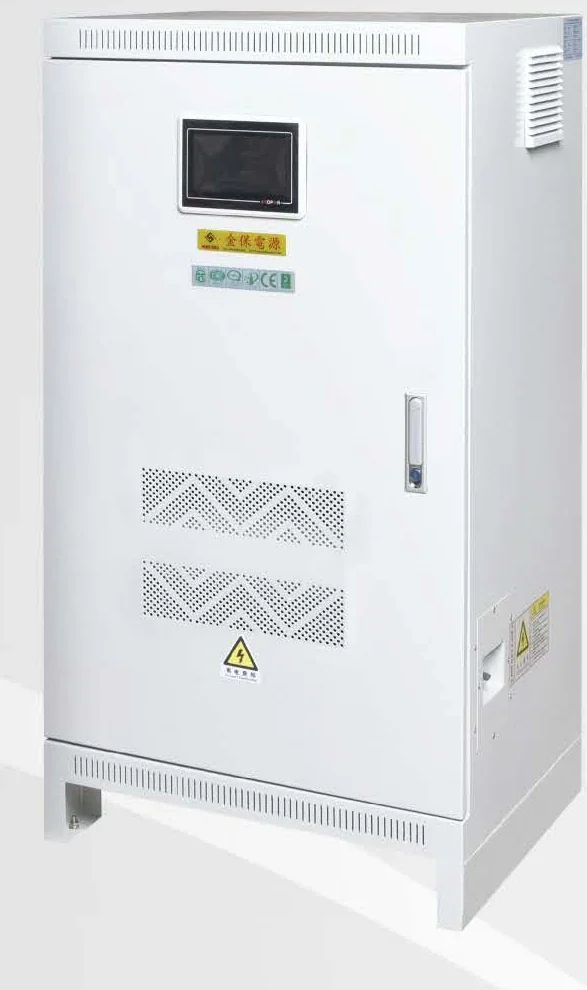
KPD Series · 10–30 kVA
Contact-Type Voltage Stabilizer
±1% precision from a carbon-brush autotransformer.
Questions from project buyers.
Project-specific answers. If your question is not here, send the load list and the site conditions.
Talk to an engineer How fast does a servo stabilizer respond?
Less than 1 second for a 10% input step, with a regulation speed of at least 25 V/s. It is not fast enough to correct a lightning transient; a surge arrester is needed for that.
Can a servo stabilizer run continuously?
Yes. It is designed for continuous operation. The brush and track wear over time, so schedule inspection and keep a spare brush.
What is the efficiency at partial load?
Above 98% at nominal load; the no-load loss is small but not zero. The exact figure depends on the model and the load.
Does it protect against lightning?
No. A stabilizer is not a surge arrester. Install a surge protective device upstream and follow local lightning protection rules.
Can it be installed outdoors?
The standard enclosure is indoor-rated. For outdoor installation, use a weatherproof enclosure with ventilation and a higher IP rating.
Send the load list. We will return the configuration.
Tell us the kW, the backup time, the phase, and the site country. You will get a capacity recommendation, a battery configuration, and the model sheet.
- Capacity and topology recommendation
- Battery bank and runtime estimate
- Model sheet and commercial offer
Request a configuration and quotation
Send the load list, backup time, and site conditions. We will return a capacity recommendation, battery configuration, and commercial offer.